Strategic Audience Analysis
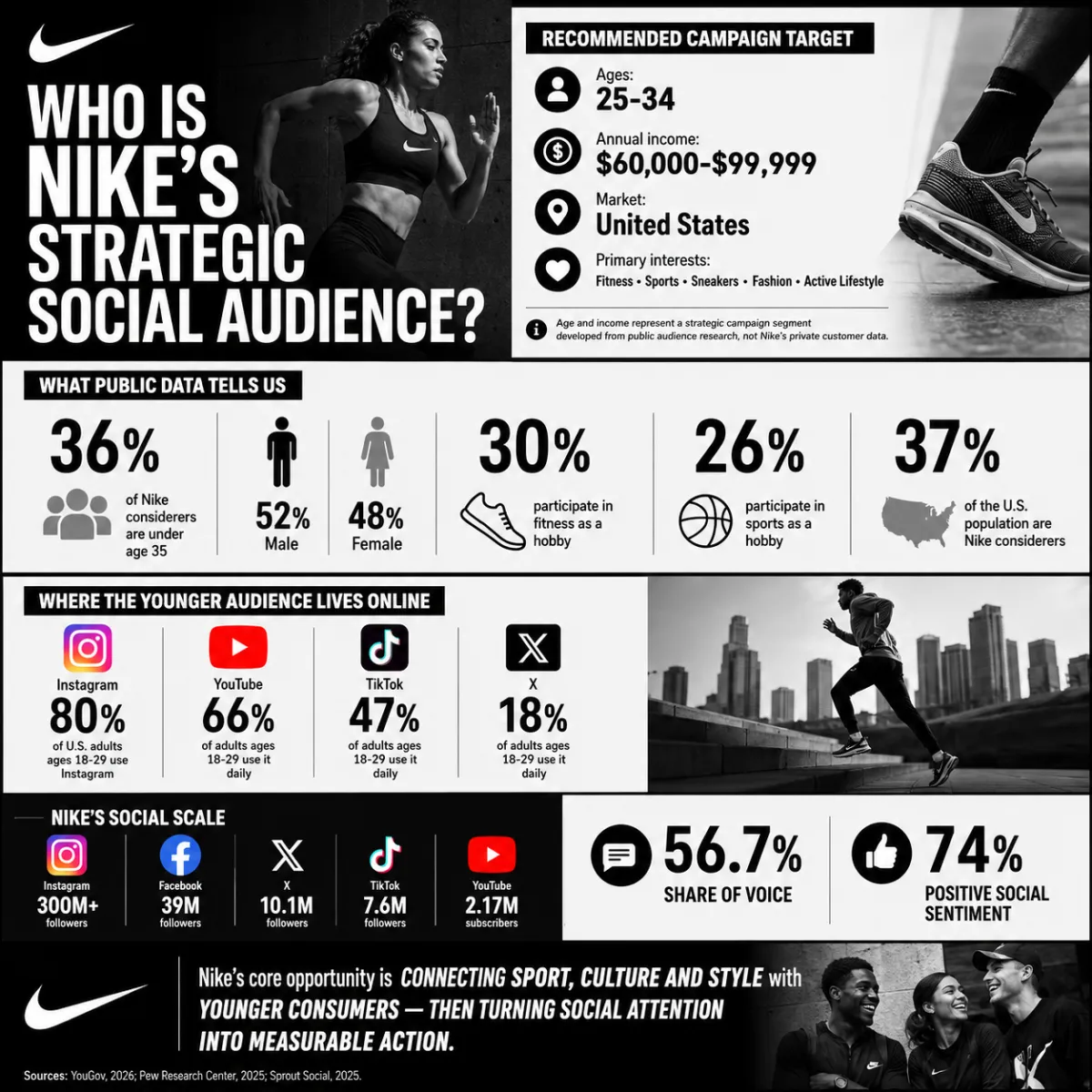
Nike's social audience reflects the brand's position at the intersection of sports, fitness, fashion and culture. For a focused U.S. campaign, the primary target audience can be strategically narrowed to adults ages 25-34 earning $60,000-$99,999 annually, particularly consumers who are active, style-conscious and interested in sports, fitness and sneaker culture. This is a campaign-specific segment rather than a claim about Nike's private customer database. Public research supports the direction: YouGov found that 36% of U.S. consumers who would consider Nike are younger than 35, compared with 30% of the general population. Nike consideration is also nearly balanced by gender at 52% male and 48% female. In addition, 30% of Nike considerers participate in fitness as a hobby and 26% participate in sports, both higher than the U.S. population overall (YouGov, 2026). These findings indicate that Nike's opportunity extends beyond elite athletes to younger working adults who view athletic products as part of both an active lifestyle and personal identity.
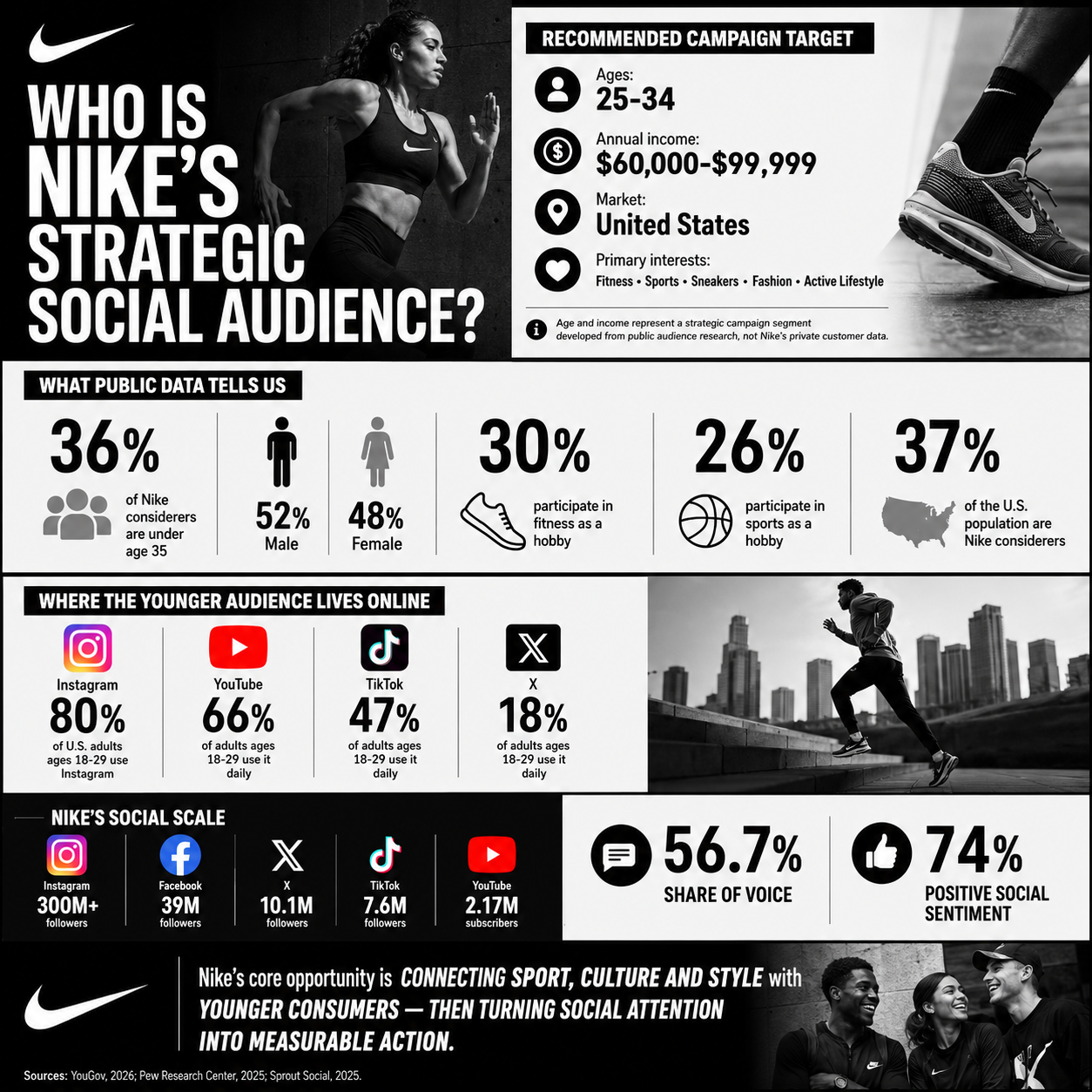
Social media behavior further supports targeting younger adults through a platform-specific strategy rather than distributing identical content across every channel. Sprout Social reported that Nike had more than 300 million Instagram followers, 39 million Facebook followers, 10.1 million followers on X, 7.6 million TikTok followers and 2.17 million YouTube subscribers in its 2025 analysis. Sprout Social also estimated Nike's share of voice against competitors at 56.7% and found 74% positive overall sentiment in its social listening data. Nike's strongest content tends to connect products with athlete stories, sporting events and cultural moments instead of relying solely on traditional product promotion. Platform behavior also differs significantly by age. Pew Research Center found that 80% of U.S. adults ages 18-29 use Instagram, while 66% use YouTube daily and 47% use TikTok daily. By comparison, only 18% of adults ages 18-29 reported using X daily. This suggests Instagram should serve as a major visual storytelling and product-discovery platform, TikTok should emphasize short-form entertainment and athlete-driven content, YouTube should support longer stories and X should remain useful for real-time sports conversations and event commentary (Pew Research Center, 2025; Sprout Social, 2025).
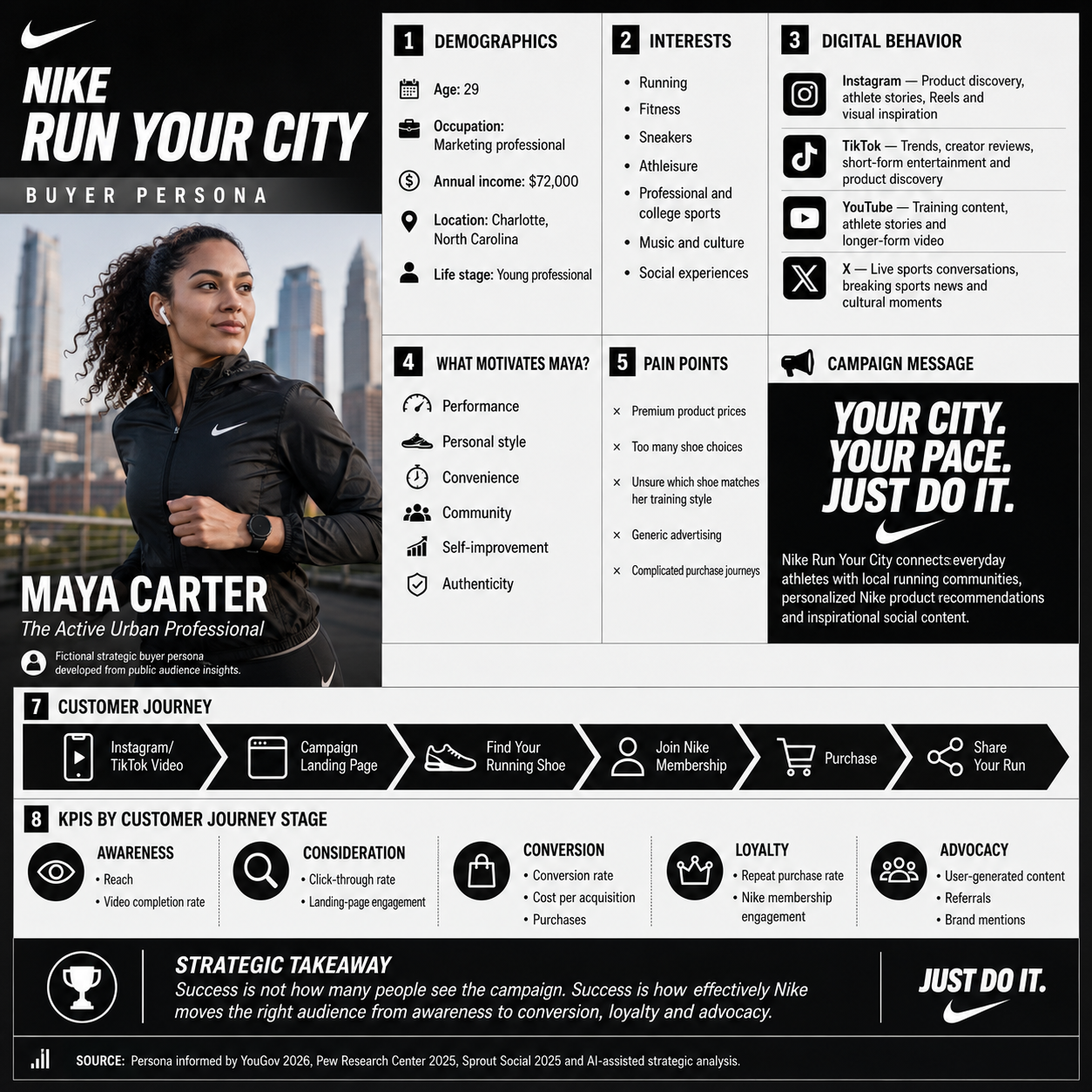
For a campaign titled "Nike Run Your City," the buyer persona is Maya Carter, a 29-year-old marketing professional earning $72,000 annually who lives in Charlotte, North Carolina. Maya exercises three to four times each week, follows professional and college sports, enjoys sneakers and athleisure, and wants products that perform well without sacrificing style. She discovers new products primarily through Instagram Reels, TikTok creators, athlete partnerships and recommendations from friends. Her barriers include premium prices, too many product choices and uncertainty about which shoe best fits her training needs. The campaign would therefore connect Nike products with local running communities, everyday athletes and personalized training goals rather than relying only on celebrity endorsements. A potential customer journey would move Maya from an inspirational Reel or TikTok video to a localized landing page, product comparison, Nike membership registration and ultimately a purchase. The campaign's key performance indicators should reflect those stages: video completion and reach for awareness; click-through rate and landing-page engagement for consideration; and conversion rate, cost per acquisition and purchases for conversion. Likes and follower counts remain useful supporting metrics, but they should not replace KPIs tied to the campaign's business objectives.
The analysis also reveals an opportunity for Nike to convert its enormous audience into deeper engagement and measurable action. Rival IQ's current athletic footwear benchmark reports about 14,900 engagements per post across the competitive landscape, while Nike recently averaged more than 196,000 engagements per post across eight posts, demonstrating the scale of its social response. Adidas remains an important benchmark, however, particularly in short-form video; a recent Adidas TikTok highlighted by Rival IQ generated about 74,300 engagements and a 0.61% engagement rate. Nike should continue emphasizing athlete storytelling, user-generated content and content created specifically for each platform while building stronger paths from social engagement to product discovery, membership and purchase. This is especially important because Nike reported that Nike Brand Digital revenue declined 12% in fiscal 2026 even as the company generated $46.4 billion in annual revenue (Nike Inc., 2026). The strategic lesson is that reach and engagement alone do not define success. Nike's most valuable KPIs should show whether attention is progressing from awareness to consideration, conversion, loyalty and advocacy.
Sources
Nike Inc. (2026). Nike Inc. reports fiscal 2026 fourth-quarter and full-year results.
Pew Research Center. (2025). Americans' social media use 2025.
Rival IQ. (2026). Athletic shoes social media benchmarks.
Sprout Social. (2025). Dissecting Nike's social media strategy: Lessons in influencer marketing and driving culture.
YouGov. (2026). U.S. fashion rankings 2026.
OpenAI. (2026). ChatGPT. AI was used to assist with organizing, interpreting and presenting publicly available data for this strategic audience analysis. No private Nike social media analytics or customer data were accessed.
